Showing posts with label Dr. Mike. Show all posts

Monday, March 21, 2011

Steve Jobs vs. Bill Gates: Who Would Choose Trent?

If Steve Jobs and Bill Gates were university-age, what university would each choose? Which would choose Trent?


From the New York Times:
Career Counselor: Bill Gates or Steve Jobs?

(Thanks to Jonathan Alphonsus for providing this link).


College students want to know what courses and majors will give them an edge in their careers. But the choices are not always clear, even if you are taking advice from Bill Gates or Steve Jobs.

In a talk to the nation's governors earlier this month, Mr. Gates emphasized work-related learning, arguing that education investment should be aimed at academic disciplines and departments that are "well-correlated to areas that actually produce jobs."

If this was not music to the ears of advocates of the humanities, they quickly found a soulmate in Steve Jobs. At an event unveiling new Apple products, Mr. Jobs said: "It's in Apple's DNA that technology alone is not enough -- it's technology married with liberal arts, married with the humanities, that yields us the result that makes our heart sing and nowhere is that more true than in these post-PC devices."

What do we know about the relationship between college studies and majors and future employment? What gets you a good first job and what leads to career success?

Read more at: http://www.nytimes.com/roomfordebate/2011/03/20/career-counselor-bill-gates-or-steve-jobs

Tuesday, February 1, 2011

Writing With a Paddle; Guest post by Mairi McGuire


Pictured here: Dr. Mike, Canadian Canoe Museum Executive Director James Raffan, Canadian Author Nicolas Dickner, Lakefield College School former Headmaster Terry Guest

This Wednesday, I was awarded the opportunity to attend a reading by award winning author, Nicolas Dicker. Dickner’s book, Nikolski, tells the story of three characters, completely unaware of their relation with one another, as they traverse separately through life. The book was the winner of CBC Canada Reads 2010 and also won the Governor General’s Literary Award for Translation in 2008. The reading was hosted at the beautiful Canadian Canoe Museum in downtown Peterborough. I was fascinated by its ornate features, the fantastical canoes which dotted the museum floor and the pillars of ancient wood which decorated the room. Nicolas Dickner was introduced by the head of Champlain College, Dr. Mike Allcott. In his introduction, Dr. Allcott described Dickner as one who “lives in the extraordinary milieu of the imagination,”, and it was right there, within the beautiful walls of the Canoe museum, that we were invited into the majestic imagination of this wonderful writer.

Wednesday, January 26, 2011

Welcoming Nicolas Dickner to Champlain


The 2011 Jack Matthews Fellow, Nicolas Dickner was welcomed to Champlain with a luncheon in the Living Learning Commons today. Trent students, students of Lakefield College School as well as VIPs from the Canadian Canoe Museum and our community.
Kate Ramsay and Dr. Mike co-hosted, and Champlainer Constance Dupuis offered welcoming remarks on behalf of Trent students.

Photos included here feature, Trent President Steven Franklin welcoming the collaborating institutions; Nicolas Dickner, Canadian Author, Dr. Mike en francais, the tourtiere main, and the sugar pie dessert.

Thursday, January 20, 2011

Dean of U of T Faculty of Law Meets with Trent Students


Professor Mayo Moran, Dean of the U of T's Faculty of Law, met with 20 engaging students in the Champlain College Living Learning Commons on January 20. Her leadership and success inspired Trent students from departments across the university; many of whom aspire to attend law school in the future. Likewise, her perspective diminished some myths about the study of law, and the University of Toronto.

Dean Moran taught secondary school in northern British Columbia after completing her BA in English and Philosophy, as well as a B.Ed at UBC. The challenges of being a young teacher in an impoverished rural school set the path of her life: she found deep meaning in the ability to change people's lives through education, and she found a deep dedication to social justice. It was only after teaching for several years that she undertook and completed her LLB at McGill, LLM at Michigan, and S.J.D. at the University of Toronto.

Her path from humble roots in northern BC to the leadership of Canada's most prestigious law school surprised students, and offered encouragement to those from backgrounds as varied as Business/Philosophy joint majors, to Fleming College transfer students. Dean Moran's comments emphasized the value of studying English and Philosophy--areas of study that build critical thinking, reading, and writing abilities--but also emphasized that no law background is necessary to study the law.

Her main advice to students was to "Do what you love, as there isn't anything more important than to be able to pursue your passions". For her, this has meant a life of learning. When she set out to do her doctoral degree in the law, the prospects for employment after graduation were slim. But the calling to study and write about the legal concept of "the reasonable person", her love of justice, and "the legal puzzle of the law" won out. And she believes her career success is testament to her belief in that principle.

Students were interested to learn that the U of T's law curriculum is actually very broad. There are many dual degree options, including a new joint J.D. and Master's of Global Affairs, as well as many avenues for studying Human Rights law, and Animal Rights--a program introduced by Dean Moran herself. Students were also interested to learn that U of T law's admissions are entirely merit-based, while their scholarships/bursaries are entirely need-based. This ensures that knowledge and ability, not economic privilege determine the quality of the 700 students in the School of Law.

Trent students enjoyed discussing a variety of topics with Dean Moran, ranging from the gender dynamics of law school and university leadership, to the ways that Canadian Law-particularly in the areas of aboriginal rights and human rights--has had global influence.


Dean Moran's visit was sponsored by Champlain College.

Thursday, December 16, 2010

CBC Book Club on "Nikolski"


Canadian author Nicolas Dickner will be in residence in Champlain as the 2011 Jack Matthews Fellow on Jan 26 and 27. Check out this interview from the CBC Book Club.

Sunday, November 28, 2010

Jill Battson, Empress of Poetry, World AIDS Day Reading at Champlain Living Learning Commons


I met Jill Battson in a bar in Buffalo, New York in 1989. Great opening line to an introduction, eh? In truth, Jill was there with Adeena Karasick, performing in a reading series for the University at Buffalo Poetics Program. Jill and I connected immediately, as we were both doing poems exploring the intersection of language, desire, pornography and performance. She blessed me by inviting me to perform in Toronto in a Weird Sisters reading along with Adeena and the inimitable Sky Gilbert. She also produced my opus, "The Porno Boy Speaks" for the Toronto Queer Culture Festival in the early '90s.

Since then Jill has achieved remarkable things as a performance poet. She's currently the poet Laureate of Cobourg, Ontario, and the opera based on her latest book, "Dark Star Requiem" opened the Luminato Festival 2010 at the Royal Conservatory of Music. She'll be reading from that book at the Champlain Living Learning Commons for World AIDS Day on Dec 1 at 3 p.m.

Over the past few years, Jill has explored in depth the relationship between spoken word performance, dance, theatre, and opera. She's done remarkable work. Here's a sample of her work with the remarkable choreoghrapher and dancer, D. A. Hoskins. (Jill, D.A., and I produced a work for Peterborough New Dance's Emergency series a few years ago entitled, "Ecce Homo").


CBC Radio 2 will broadcast a recording of the world premiere of "Dark Star Requiem" later in the evening of World AIDS Day. The dramatic oratorio by Jill Battson and composer Andrew Staniland, was co-produced by Tapestry and Luminato, Toronto Festival of Arts and Creativity, for the opening weekend of the 2010 Festival.

The Toronto Star called the oratorio “Artistically adventurous and intellectually provocative” and “exactly the kind of project that the Luminato festival wants to be about.” Classical Music Guide called it, “a ‘tapestry’ quite consistently mesmerizing to the collective senses and conscience of the rapt audience” and “a work of vital . . . lasting, thought-provoking power.” Listeners will be able to follow the text and view production images online at http://www.tapestrynewopera.com/.

Broadcast Details:
December 1, 2010
on The Signal with Laurie Brown
CBC Radio 2
Between 10 pm and midnight EST.

Thursday, November 25, 2010

In Memoriam: former Master of Champlain, Jim MacAdam


As many Champlain students know, Noranne and I were very saddened to learn last week of the death of Professor Jim MacAdam, who served as Master of Champlain from 1987 to 1995. Noranne knew him very well, and I was fortunate to have met him during my first term as Head of the college. In fact, he was a part of Champlain life recently, and attended the gala opening of the Champlain Living Learning Commons early in November.

Another previous Master of Champlain, Professor Emeritus John Burbidge, gave remarks at a memorial for Professor MacAdam that was held in the former Champlain Master's Lodge yesterday, November 24, 2010. His remarks included memories shared by Professor Emeritus David Gallop, another colleague from Trent's Philosophy Department. I thought that current Champlain students and readers of this blog would appreciate reading these remarks, not only as a remembrance of an extraordinary leader of our community, but also as a window into the deep history and character of Champlain College. Many thanks to Professors Burbidge and Gallop for sharing this text with us.

JAMES MacADAM 1930-2010

A number of years ago, a young Jim MacAdam enrolled in the MA program in philosophy at Queen's University. In those glorious days, every incoming student was interviewed by the registrar, and so Jim found himself in front of the formidable Jeannie Royce. She looked at his file: “I see that you have been teaching physical education. What made you decide to take up philosophy?” “Well,” Jim replied, “I've had th-th-th-three c-c-c-concussions!”

That little story sums up a number of key features of Jim. In the first place, the fact that he was the butt of his own stories reveals how comfortable he was in his own skin. He was never overwhelmed by adversity, but always faced life with a positive and enthusiastic interest, seeing “the funny side of any situation.” As David Gallop writes: “This extended even to his own severe injury from the car accident in 1988. In recovering from that trauma, and in completing his term as Master of Champlain College, he showed the utmost fortitude and nobility of spirit.”

Second, he was a jock, playing rugby and baseball when he was young; later on, golf in the summer and curling in the winter. When his blunted left hand prevented him from holding the broom to maintain his balance on the curling rink, he would just reach out that arm as far as possible, making an interesting spectacle as he slid down the ice.

Third, he loved philosophy, even more than athletics and, quoting David Gallop again, “was unswerving in his dedication to it and inventive in its teaching. His many bold academic initiatives included the international conference on Jean-Jacques Rousseau at Trent in 1978 which initiated the North American Rousseau Society, the use of 'moots', or 'mock-trials', in philosophy-of-law courses, with collaboration from the legal profession, and two series of lectures on Great Philosophers in the Peterborough Public Library.” After he retired he discovered some unpublished writings of H.A. Prichard, an eminent Oxford philosopher, and edited them into a fine volume, published by Oxford University Press and dedicated “For the Love of my Wife, Elizabeth, and our Children”.

But there are other features that are only implicit in that little story of Jeannie Royce. Jim was committed to undergraduate teaching, maintaining a continual guerilla war against the moves made to establish graduate programs in the humanities. David Gallop: “He probably fitted, better than anyone else at Trent, the image that many people have of 'the true philosopher', a role that he filled in the most endearing fashion. [David} still remember[s] an occasion when Jim was lecturing on Thomas Hobbes, and a pneumatic drill started up right outside the lecture-theatre. He remained quite unfazed, and doggedly plunged ahead with his lecture, despite being completely inaudible for about ten minutes.” Students recall the time when, in a tutorial, he leaned back in his chair to expound on a point and, as the chair continued its arc towards the floor, Jim went on, equally unfazed, with his exposition.

Jim was committed to Champlain College. He had the only office in the university which gives directly on to the river and once, in the middle of a class, he wandered over to the window, where a bell on a fishing rod was jangling, and calmly reeled in a small bass. His interest in all aspects of college life reached its culmination when he was appointed Master in 1987, and Jim and Betty became involved closely with the many and diverse students who made up the college community welcoming them into the warmth of this room.

Finally, and most important, Jim was a friend. I don't mean simply that he was my valued friend, though that is true enough. But he was a friend to the very core of his being. As David says: “He was an ideal mentor for someone new to Trent, because he personified all that the University and its college system stood for.” The young Harry and Caroline Kitchen, uncertain as, for the first time, they approached the Master's Lodge and an initial encounter with the redoubtable William and Peg Morton, were greeted by Jim and Betty and made to feel at home. The two of them, Jim and Betty, were genial and kindly hosts, regularly entertaining supervisees and students over a meal in their home. Jim continued to follow the careers of former students and towards the end was contemplating a visit to Tony Arthur, High Commissioner from the Barbados to the Court of St. James.

Let me conclude with, once again, the words of David Gallop: “When the next history of Trent comes to be written, Jim will surely deserve to be chronicled as one of its most courageous early pioneers. For now, he will be remembered with affection by everyone who was warmed by his friendship and by his generosity of heart.”

--John Burbidge

From Trent University to the Kennedy Center for the Performing Arts in Washington DC


A shout out to Nomadic Massive who loved their stay at Champlain and the great students who helped them launch their tour this fall at Trent.

The climax of their tour (and the band's life thus far!) was this concert at the prestigious Kennedy Center for the Performing Arts in Washington DC. Champlain knows what's good, eh?

http://www.kennedy-center.org/explorer/videos/?id=M4455

Saturday, November 13, 2010

What is Remembrance Day all about?

I was honoured to be a part of a Remembrance Day ceremony in the Great Hall of Champlain on Thursday morning. It was a privilege to share the podium with a Trent student, Ethan Mcdonald, who is an officer Cadet in the Canadian armed forces. I was very moved by the depth of thought, reflection, feeling, and commitment in the words that he shared that day. I'm grateful that he shared that text with me so that you might read it here.

What is Remembrance Day all about?

When I was young, it was about wearing a little red flower in November. Growing up, it took on a human side; a wrinkly face with white thinning hair and bright eyes despite failing health with age.

Today as I wear this uniform, it means much more and I would like to share this with you.

After taking several history courses in high school and university, I discovered that often, war was waged for political or religious reasons and very often unknown to those whom it consumed. Rarely did it bring what was promised: freedom and a better life for those it affected; and war rarely brought peace.

I was taught that long ago, men went overseas and fought for their home country in the Great War, to bring back peace and victory for the commonwealth. In 1917 our great nation was born under fire in France. Young Canadians took the untakeable at Vimy Ridge and endured the unendurable at Passchendaele, many never leaving Flanders Fields. The armistice took place one year later--the eleventh hour of the eleventh day of the eleventh month 1918. Never again!

In 1939, the nations of the world mobilized once again for another round, this time the Allies were off to fight amongst others, a man named Adolf Hitler and his armies who in a short time, controlled most of Europe. Once again, young Canadians answered the call and scaled the cliffs of Assoro, suffered in Hong Kong and took Juno Beach. Six years later they returned with victory and an uneasy peace. The world learned of the horrors of the holocaust and wept from the devastation. Never again!

For the next 45 years, the world held its breath while Western and Communist armies sparred in remote regions of the world. Canadians held the unholdable at Kapyong and in the 90’s when United Nations peace keeping became the political focus, Canadians in sky blue berets of hope, sat out of a politically incorrect war and watched as millions were murdered in Rwanda. Never again!

I suppose it would sound rather cynical for me to say this and suggest that war has never accomplished anything worth its cost; that by this perhaps, the deeds of veterans are meaningless. If you only focus on the big picture and not what’s in an individual’s heart, this may be all that you believe. However, I do not come to you today to preach on the politics or history of international conflict. My query is much simpler; not why we have war, but why we have warriors?

The truth is, regardless of politics, regardless of race, religion, ethnicity or anything else that separates and divides humans or causes war; veterans and soldiers of conflicts past and present serve because they feel a duty. A duty to do all that is in their power to bring peace, freedom and a higher quality of life, to those who are without it. For any individual to take action on their beliefs especially with goals such as these is truly remarkable.

The truth is, even today within this great nation of Canada, there are still thousands who take up this cause. They are deployed to the Middle East, in Afghanistan and other troubled areas around the world. Regardless of their job, they all make a sacrifice, the same as those before them. Leaving their families, their daily lives and country behind and donning the uniform of a Canadian Soldier. All gave some; some 152 of my brothers and sisters gave all, giving their lives for what they believe in.

I can tell you this with absolute certainty today as I don the uniform of a Canadian Soldier as many nineteen year olds have done before me. My profession is that of arms, my job is to fight. Yet my mission is to preserve peace, to ensure freedom and quality of life for all. My mind says “Never again!” but my heart says, “I must do something!”

So today on the eleventh of November, many may ponder the question “What does Remembrance Day mean?” To me, it is a day to remember the conflicts of the past and present, but focusing on the men and women who serve instead of dwelling on politics or the outcome. Remembrance Day is about people, who became soldiers, who went off to war and fought for what they believe in.

Remembrance Day is about those who never made it home. We will remember them.

- A Canadian Soldier.

Friday, November 12, 2010

Tim Miller, Internationally Acclaimed Performance Artist


Champlain is honoured to host Tim Miller, whose work as a performer and writer explores the artistic, spiritual and political topography of his identity as a gay man. Hailed for his humor and passion, Miller's performances have been presented all over North America, Australia, and Europe in such prestigious venues as Yale Repertory Theatre, the Institute of Contemporary Art (London), the Walker Art Center (Minneapolis), and the Brooklyn Academy of Music. For more information, visit: www.timmillerperformer.com

Tim has been my friend for many years. I taught his book, "Shirts and Skins" as well as excerpts of his work in the book "O Solo Homo" when I taught a class in Queer Performance Art for the University of Utah (at the Gay and Lesbian Community Center in Salt Lake City). His performance works embody so much of the history of gay culture over the past 2 decades. And his commitment to continuing to fight, through artistic expression, for the rights and well-being of queer-identified people everywhere is an inspiration.

I'm thrilled that our Champlain community will be able to welcome him and learn with him in residence at the college for the next few days.

If you want to learn more about his schedule here, check out these links, and pick up tickets to see his show on Wednesday night at the First People's Performance Space.
http://www.facebook.com/TimMillerPerformer#!/event.php?eid=122410101153528
http://www.facebook.com/TimMillerPerformer#!/event.php?eid=101084199965203


Thursday, October 14, 2010

Canoeing and Cultural Learning

ESL Canoeing Program with Canoe Museum from Fusionriver Photography on Vimeo.


A great photo essay of a Trent ESL Class's adventure-learning with the Canadian Canoe Museum.

ESL students: post a comment about your experience in the box below!
All the best, Dr. Mike

Sunday, September 19, 2010

Nomadic Massive Live in the Great Hall, Sep 24 7 p.m.


Why Nomadic Massive as a kick off event to bring Trent together for a Champlain event?

When Tim Shah (Champlain/Trent alumn, leader of the Trent Global Living Community, and now at UBC doing a Master's in Urban Planning) first contacted Nomadic Massive to see if they would do a performance in the Great Hall on their way to a gig in Toronto, they responded immediately and said that they love to do performances at universities--but . . ."

We might have been worried about the "but" until it was followed by, "we'd also like to do a workshop for social justice". Tim and I were both thrilled because, well, how Trent is that? A cutting edge eleven piece band making the great hall rumble with a multicultural sound--and a message with meaning to make a world of difference? That's a college life I want to be a part of!

When I came to Champlain 7 years ago, I heard many stories about "the old days" of concerts and sweaty dance parties in the Great Hall that brought together the community in ways no other college could. That's one tradition I'd like to sustain--if it gives us opportunities to learn together as this concert will!

Nomadic Massive, live in the Great Hall, with opening band The Resolutionaries, Friday, September 24, 2010, 7 p.m. Get tickets at the Champlain College Office, LEC Office, TIP, The Central or student affairs. Tickets are free with a donation for Pakistan Flood Relief (UNICEF).

Workshop: "Social Justice Through Hip Hop" World Affairs Colloquium in the Champlain Council Chambers (CC M2) at 3 p.m.

Wednesday, September 8, 2010

College Head Welcome and Tree Planting


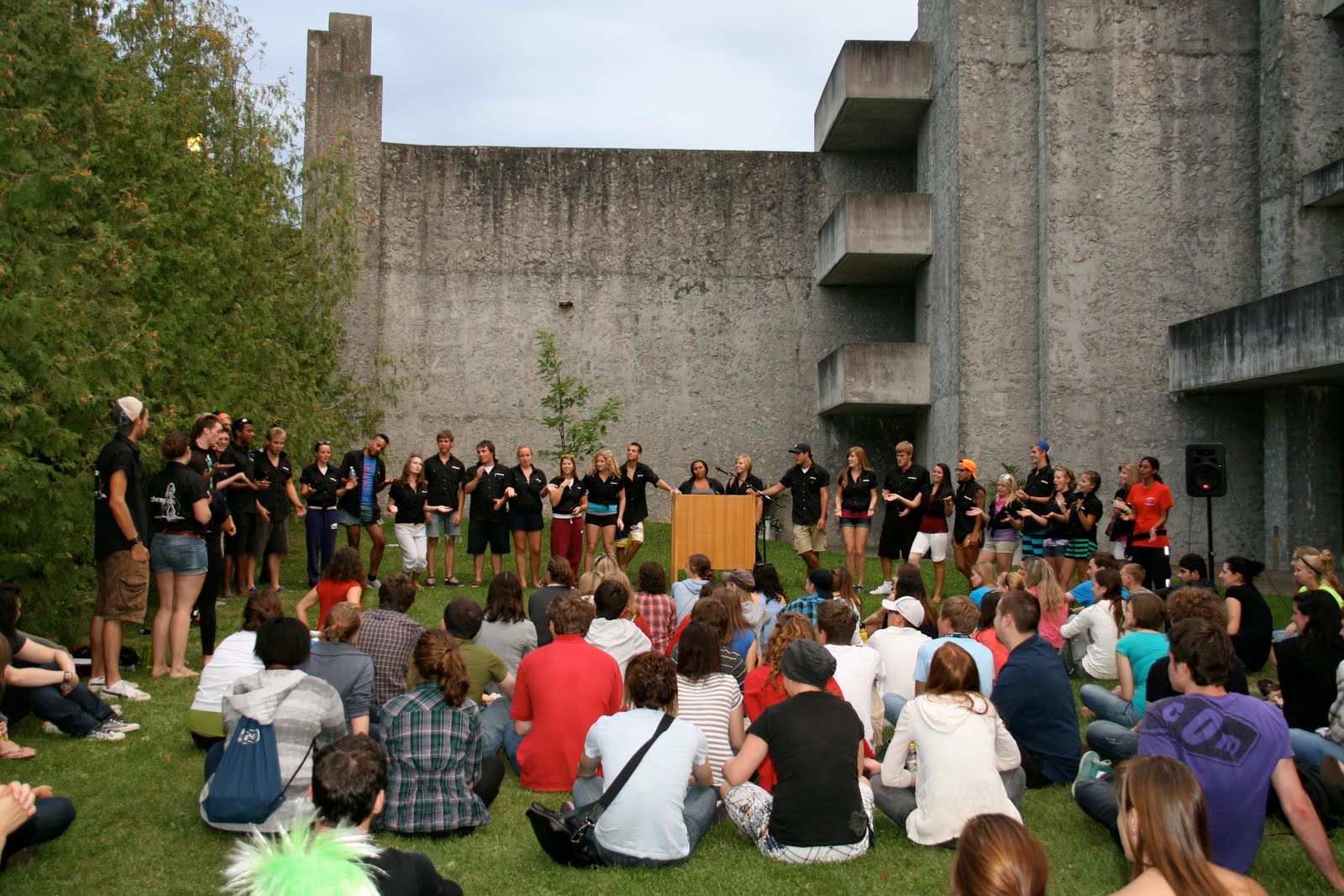
On September 7, 2010, Dr. Mike Allcott, Champlain College Head welcomed all new students of Champlain by planting a tree in their honour. If you weren't able to attend, below is the talk he shared with the new students!

Welcome to Trent and welcome to Champlain College.

My academic background is in English Literature and my professional experience has led me to travel and live in more than 20 countries around the world. Both of these things mean that I look for and see meaning in all the different aspects of life. And I think you do, too. Meaning is the value of the things we do, of the friendships we make of the things we learn. The absence of meaning, is well, it’s simply boring. Like going through the motions of a dance that you don’t understand or don’t want to do.

So I wanted to spend this moment of meaning with you, in the hope that we can share a value, not just for this moment, but for the lifespan of this little oak tree. As many of you know, my partner and I were married 6 years ago in this little courtyard of Champlain College, so it has great meaning for me. There was a great willow tree, a love willow, with two trunks entwined in each other right at this spot. Sadly, that tree passed on a few years ago. And that’s one reason I wanted to plant this tree in your honour this week.

This tree was planted for the Trent University and Champlain College class of 2010. That’s you.

And as members of this very special community of learning, we’ll be able to watch the tree grow over the next year or two or three or four (or maybe more). It will be a way for us to measure each other’s growth, witness each other’s progress, and celebrate each other as we grow and become what we’re only brave enough to dream at this point.

Those of us who have a social and environmental consciousness know that planting a tree is an essential act of life and hope. Trees and reforestation not only help to digest the overabundance of Carbon Dioxide produced by our abuse of the earth, they also provide a natural habitat and a healthy diverse ecosystem that helps to sustain other life. Moreover, trees are beautiful: recent studies have showed that people who are able to see trees and their natural environment experience a more peaceful and stress-free life; people who study within sight of trees have higher level of concentration and the ability to focus. As you may know ancient druids found spiritual force in the very existence of trees. And whether you are a spiritual person or a scientific person, maybe there is some actuality in that belief that we have yet to discover.

What do they say about your generation? The first generation to come of age after September 11, 2001. That was a moment that changed the way Americans, but also north Americans thought about our security and being in the world. Your parents may have paid more careful attention to you, to your well-being and to your safety than previous generations.

The researchers call you “Generation Net”, because you have grown up in a world where the internet was not a new phenomenon, but as normal a part of life as milk, maple syrup and MTV.

Researchers say that you have high expectations of University:

That is will truly prepare you for the Future. You trust that university will provide you a safe and supportive environment, in which you will be able to take risks and rise to meaningful challenges. And in which you’ll be able to have a second chance when that risk does not result in success.

You expect university to provide you Mentors. People whose experience you can look up to, and people who can not only help guide you to success, but help connect you to the networks that lead to success.

But you expect those mentors to arise from authentic circumstances—from your real life, not from a competition or one-upsmanship over your peers.

You expect university to challenge you—but not in an environment of merely formulaic tests and exams, but in meaningful challenges. Projects, assignments, opportunities inside and outside the classroom that add to your sense of meaning in life.

Oh, and the researchers say that you expect to have fun. I hope that you will find that Champlain College, the friends you will make here, the mentors you will meet in the authentic day to day life of the college, will meet these lofty expectations of your generation.

There’s another thing that people believe about your generation: They call you Generation O. That’s O for Obama. Social networking, genuine belief that the institutions created by your seniors can be an effective tool for changing the world into the world that you want. That you not only have a social consciousness, but you have the will to participate and the savoir-faire to make things work for you.

We’re planting this tree tonight as a sign of our commitment to each other, to Champlain College. It’s a sign that we will guard and value each other’s expectations, and support each other’s dreams as we grow together over the next years. And we’ll look forward to the moment we can look back with your children when they come to Trent, or that this tree will look back on us from its hundreds of years of life, and appreciate the moment we were at Champlain.

Noranne has a guest book for each of you to sign either tonight, or in the Great Hall throughout the week. I’d like you to put your name there—and if you would, record some word that indicates your dreams or desires for yourself as a member of this community of learning.

Who will you be? Who will you form friendships with? What will you learn? What will you teach? And what will you give to this community? I and the fellows of Champlain look forward to watching you become whomever you will be. Thank you for coming tonight, enjoy your ISW, and welcome the class of 2010 to Champlain College.

Friday, September 3, 2010

In Istanbul, 8,000 Years of History - NYTimes.com


As many Champlain Fellows have research and cultural interest in Turkey and especially Istanbul, I wanted to share this with the college community. Trent faculty in Ancient History & Classics, Politics, Geography, History, Anthropology have research interests in this region. (If there are others, I'd be interested in knowing).

In Istanbul, 8,000 Years of History - NYTimes.com

Monday, August 23, 2010

Inspirational Leadership and Sustainable Values,

Aspen Ideas Festival 5772010 Audio / Video Library: "Inspirational Leadership and Sustainable Values"


This is an hour-long talk with Thomas Friedman and Dov Seidman at the Aspen Ideas Festival 2010. Well worth a listen for the values of ethical leadership they espouse.

Wednesday, June 30, 2010

Urban Planning, Suburban Re-Planning

I know several Champlainers who are deeply interested in urban planning, especially the need to rethink the way cities (even small cities in Ontario) work in order to be environmentally sustainable. I'd be interested in knowing what you think about this lecture (20 minutes) "Retrofitting Suburbia" by Ellen Dunham-Jones.