Let us set the stage- a mild February afternoon, the snow still drifting after the storm, a slight wind, ruffling strands of hair and the fringes of scarves, dozens of Champlain Students, some still dazed from the night before, gloved hands gripped on the wooden sticks, crouched over the smooth palette of ice, prepared for what will happen next. N-H-L, they chant, hitting their sticks against one another, before swiping at the small, brightly colored rubber ball.
An online dialogue connecting students, alumni, faculty and friends of Champlain College at Trent University in Peterborough, Ontario, Canada. This blog will act as a resource for students, fellows, and alumni, and also connect college members living off-campus with on-campus events, social functions and special talks.
Showing posts with label History of Champlain. Show all posts
Thursday, February 10, 2011
Bon Temps Weekend 2011 - post by Mairi "McGee" Mcguire
Let us set the stage- a mild February afternoon, the snow still drifting after the storm, a slight wind, ruffling strands of hair and the fringes of scarves, dozens of Champlain Students, some still dazed from the night before, gloved hands gripped on the wooden sticks, crouched over the smooth palette of ice, prepared for what will happen next. N-H-L, they chant, hitting their sticks against one another, before swiping at the small, brightly colored rubber ball.
Labels:
College Events,
Community,
History of Champlain,
Mairi
Thursday, November 25, 2010
In Memoriam: former Master of Champlain, Jim MacAdam


As many Champlain students know, Noranne and I were very saddened to learn last week of the death of Professor Jim MacAdam, who served as Master of Champlain from 1987 to 1995. Noranne knew him very well, and I was fortunate to have met him during my first term as Head of the college. In fact, he was a part of Champlain life recently, and attended the gala opening of the Champlain Living Learning Commons early in November.
Another previous Master of Champlain, Professor Emeritus John Burbidge, gave remarks at a memorial for Professor MacAdam that was held in the former Champlain Master's Lodge yesterday, November 24, 2010. His remarks included memories shared by Professor Emeritus David Gallop, another colleague from Trent's Philosophy Department. I thought that current Champlain students and readers of this blog would appreciate reading these remarks, not only as a remembrance of an extraordinary leader of our community, but also as a window into the deep history and character of Champlain College. Many thanks to Professors Burbidge and Gallop for sharing this text with us.
JAMES MacADAM 1930-2010
A number of years ago, a young Jim MacAdam enrolled in the MA program in philosophy at Queen's University. In those glorious days, every incoming student was interviewed by the registrar, and so Jim found himself in front of the formidable Jeannie Royce. She looked at his file: “I see that you have been teaching physical education. What made you decide to take up philosophy?” “Well,” Jim replied, “I've had th-th-th-three c-c-c-concussions!”
That little story sums up a number of key features of Jim. In the first place, the fact that he was the butt of his own stories reveals how comfortable he was in his own skin. He was never overwhelmed by adversity, but always faced life with a positive and enthusiastic interest, seeing “the funny side of any situation.” As David Gallop writes: “This extended even to his own severe injury from the car accident in 1988. In recovering from that trauma, and in completing his term as Master of Champlain College, he showed the utmost fortitude and nobility of spirit.”
Second, he was a jock, playing rugby and baseball when he was young; later on, golf in the summer and curling in the winter. When his blunted left hand prevented him from holding the broom to maintain his balance on the curling rink, he would just reach out that arm as far as possible, making an interesting spectacle as he slid down the ice.
Third, he loved philosophy, even more than athletics and, quoting David Gallop again, “was unswerving in his dedication to it and inventive in its teaching. His many bold academic initiatives included the international conference on Jean-Jacques Rousseau at Trent in 1978 which initiated the North American Rousseau Society, the use of 'moots', or 'mock-trials', in philosophy-of-law courses, with collaboration from the legal profession, and two series of lectures on Great Philosophers in the Peterborough Public Library.” After he retired he discovered some unpublished writings of H.A. Prichard, an eminent Oxford philosopher, and edited them into a fine volume, published by Oxford University Press and dedicated “For the Love of my Wife, Elizabeth, and our Children”.
But there are other features that are only implicit in that little story of Jeannie Royce. Jim was committed to undergraduate teaching, maintaining a continual guerilla war against the moves made to establish graduate programs in the humanities. David Gallop: “He probably fitted, better than anyone else at Trent, the image that many people have of 'the true philosopher', a role that he filled in the most endearing fashion. [David} still remember[s] an occasion when Jim was lecturing on Thomas Hobbes, and a pneumatic drill started up right outside the lecture-theatre. He remained quite unfazed, and doggedly plunged ahead with his lecture, despite being completely inaudible for about ten minutes.” Students recall the time when, in a tutorial, he leaned back in his chair to expound on a point and, as the chair continued its arc towards the floor, Jim went on, equally unfazed, with his exposition.
Jim was committed to Champlain College. He had the only office in the university which gives directly on to the river and once, in the middle of a class, he wandered over to the window, where a bell on a fishing rod was jangling, and calmly reeled in a small bass. His interest in all aspects of college life reached its culmination when he was appointed Master in 1987, and Jim and Betty became involved closely with the many and diverse students who made up the college community welcoming them into the warmth of this room.
Finally, and most important, Jim was a friend. I don't mean simply that he was my valued friend, though that is true enough. But he was a friend to the very core of his being. As David says: “He was an ideal mentor for someone new to Trent, because he personified all that the University and its college system stood for.” The young Harry and Caroline Kitchen, uncertain as, for the first time, they approached the Master's Lodge and an initial encounter with the redoubtable William and Peg Morton, were greeted by Jim and Betty and made to feel at home. The two of them, Jim and Betty, were genial and kindly hosts, regularly entertaining supervisees and students over a meal in their home. Jim continued to follow the careers of former students and towards the end was contemplating a visit to Tony Arthur, High Commissioner from the Barbados to the Court of St. James.
Let me conclude with, once again, the words of David Gallop: “When the next history of Trent comes to be written, Jim will surely deserve to be chronicled as one of its most courageous early pioneers. For now, he will be remembered with affection by everyone who was warmed by his friendship and by his generosity of heart.”
--John Burbidge
Labels:
College,
College Fellows,
Community,
Dr. Mike,
History of Champlain
Wednesday, September 8, 2010
College Head Welcome and Tree Planting
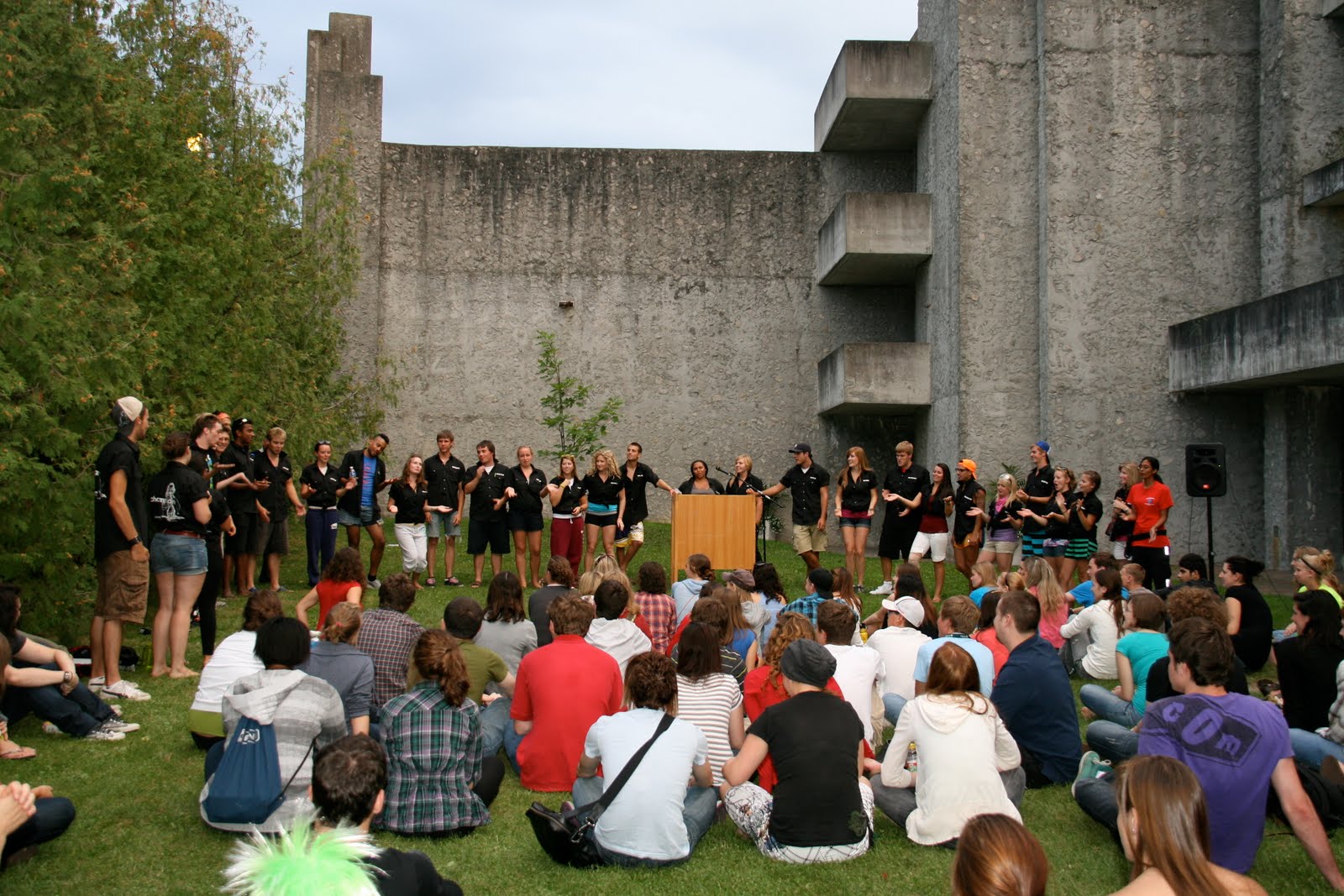
On September 7, 2010, Dr. Mike Allcott, Champlain College Head welcomed all new students of Champlain by planting a tree in their honour. If you weren't able to attend, below is the talk he shared with the new students!
Welcome to Trent and welcome to Champlain College.
My academic background is in English Literature and my professional experience has led me to travel and live in more than 20 countries around the world. Both of these things mean that I look for and see meaning in all the different aspects of life. And I think you do, too. Meaning is the value of the things we do, of the friendships we make of the things we learn. The absence of meaning, is well, it’s simply boring. Like going through the motions of a dance that you don’t understand or don’t want to do.
So I wanted to spend this moment of meaning with you, in the hope that we can share a value, not just for this moment, but for the lifespan of this little oak tree. As many of you know, my partner and I were married 6 years ago in this little courtyard of Champlain College, so it has great meaning for me. There was a great willow tree, a love willow, with two trunks entwined in each other right at this spot. Sadly, that tree passed on a few years ago. And that’s one reason I wanted to plant this tree in your honour this week.
This tree was planted for the Trent University and Champlain College class of 2010. That’s you.
And as members of this very special community of learning, we’ll be able to watch the tree grow over the next year or two or three or four (or maybe more). It will be a way for us to measure each other’s growth, witness each other’s progress, and celebrate each other as we grow and become what we’re only brave enough to dream at this point.
Those of us who have a social and environmental consciousness know that planting a tree is an essential act of life and hope. Trees and reforestation not only help to digest the overabundance of Carbon Dioxide produced by our abuse of the earth, they also provide a natural habitat and a healthy diverse ecosystem that helps to sustain other life. Moreover, trees are beautiful: recent studies have showed that people who are able to see trees and their natural environment experience a more peaceful and stress-free life; people who study within sight of trees have higher level of concentration and the ability to focus. As you may know ancient druids found spiritual force in the very existence of trees. And whether you are a spiritual person or a scientific person, maybe there is some actuality in that belief that we have yet to discover.
What do they say about your generation? The first generation to come of age after September 11, 2001. That was a moment that changed the way Americans, but also north Americans thought about our security and being in the world. Your parents may have paid more careful attention to you, to your well-being and to your safety than previous generations.
The researchers call you “Generation Net”, because you have grown up in a world where the internet was not a new phenomenon, but as normal a part of life as milk, maple syrup and MTV.
Researchers say that you have high expectations of University:
That is will truly prepare you for the Future. You trust that university will provide you a safe and supportive environment, in which you will be able to take risks and rise to meaningful challenges. And in which you’ll be able to have a second chance when that risk does not result in success.
You expect university to provide you Mentors. People whose experience you can look up to, and people who can not only help guide you to success, but help connect you to the networks that lead to success.
But you expect those mentors to arise from authentic circumstances—from your real life, not from a competition or one-upsmanship over your peers.
You expect university to challenge you—but not in an environment of merely formulaic tests and exams, but in meaningful challenges. Projects, assignments, opportunities inside and outside the classroom that add to your sense of meaning in life.
Oh, and the researchers say that you expect to have fun. I hope that you will find that Champlain College, the friends you will make here, the mentors you will meet in the authentic day to day life of the college, will meet these lofty expectations of your generation.
There’s another thing that people believe about your generation: They call you Generation O. That’s O for Obama. Social networking, genuine belief that the institutions created by your seniors can be an effective tool for changing the world into the world that you want. That you not only have a social consciousness, but you have the will to participate and the savoir-faire to make things work for you.
We’re planting this tree tonight as a sign of our commitment to each other, to Champlain College. It’s a sign that we will guard and value each other’s expectations, and support each other’s dreams as we grow together over the next years. And we’ll look forward to the moment we can look back with your children when they come to Trent, or that this tree will look back on us from its hundreds of years of life, and appreciate the moment we were at Champlain.
Noranne has a guest book for each of you to sign either tonight, or in the Great Hall throughout the week. I’d like you to put your name there—and if you would, record some word that indicates your dreams or desires for yourself as a member of this community of learning.
Who will you be? Who will you form friendships with? What will you learn? What will you teach? And what will you give to this community? I and the fellows of Champlain look forward to watching you become whomever you will be. Thank you for coming tonight, enjoy your ISW, and welcome the class of 2010 to Champlain College.
Thursday, August 26, 2010
Perspective on Champlain College from the New College Head
I’ve been a fellow of Champlain since I came to Trent University in 2003. Being a part of the community of faculty, staff and student members of the college, being involved in academic advising and college events, has been very valuable to me. Mainly I value the students whom it has been my pleasure to mentor, either through the Trent Global Living Community, the International Program (TIP), Trent Reads seminars, leadership work, or college activities. Students’ success is what makes my academic life meaningful.
Many of my Champlain and Trent colleagues were a part of a very important moment of my life: my partner and I were married in the cedar-lined courtyard between the Great Hall and the river in July of 2004. Yes, it was a beautiful spot for a wedding, but it was all the more memorable because our friends and families from around the world were welcomed here by our new Trent colleagues and friends.
The spirit of Champlain distinguishes us from the other Trent colleges, and from other colleges I’ve experienced. (At Cambridge University in England, I lived in both Selwyn and Newnham, where I was also a summer resident tutor). Champlain includes a remarkable range of people and perspectives, so it is no wonder that we’re known for being ready to voice our critical perspectives on significant issues. We’re also known for being fearless about taking a stand on controversial issues. And, perhaps because of the tradition of the Lumberjacks broomball team, or because it was Champlainers who pioneered this Trent campus when they moved in during the grey winter days of 1967, we have a reputation for being rugged and adventurous.
Champlain is inclusive of many characters and inspirations. The International Program’s (www.trentu.ca/tip) presence here, as well as The Seasoned Spoon cafĂ© (www.trentu.ca/stuorg/seasonedspoon) ensure that the dynamism of Trent’s diversity is at the heart of college life.
Collegiality is a core principle of this learning community. College Fellows set Champlain’s collegial tone through the TRIPS (Trans-disciplinary Research In Progress Seminar). These faculty seminars bring together professors and instructors from across the interdisciplinary spectrum of the university to supportively share and develop research. Produced by the International Development Studies department, TRIPS provides faculty an opportunity to present their work-in-progress in order to gain the perspective and analytic insight of colleagues and peers.
The presence of departments like IDS, Politics, and Ancient History and Classics, also distinguishes the college. With that mix of globally-oriented departments, spanning the arts and social sciences, it was no accident that TIP was welcomed into the college as a part of a vision for internationalizing the experience of our entire community. Fellows from History, Anthropology, Environmental Resource Studies, Biochemistry and other science departments ensure our dynamism. Likewise, integral to a vision of the college as both a residence and a community of learning for students and faculty who live elsewhere, the Trent Global Living Community was established at Champlain; TGLC is not only a model for success for other LLC’s at Trent, but has a strong alumni tradition, with successful former residents all around the world. Likewise, the Active Living Community and La Maison Francaise are poised to lead the college in engagement and co-curricular learning.
My experience is that Champlain is home to people who like to accomplish things, whether those things are academic, athletic, social, or service to the world. We’re doers. That spirit harkens to a strong line in the tradition of liberal arts and sciences education: we are inspired by idealism, motivated to think critically and research carefully—and we are fully engaged in the real world. As the head of the college, I look forward to cultivating and supporting that spirit, and to fulfilling the potentials of this unique community of learning through engaging the interests and energies of the students and fellows of Champlain.
Let me know if you think I'm hearing and perceiving the Champlain you know!
Many of my Champlain and Trent colleagues were a part of a very important moment of my life: my partner and I were married in the cedar-lined courtyard between the Great Hall and the river in July of 2004. Yes, it was a beautiful spot for a wedding, but it was all the more memorable because our friends and families from around the world were welcomed here by our new Trent colleagues and friends.
The spirit of Champlain distinguishes us from the other Trent colleges, and from other colleges I’ve experienced. (At Cambridge University in England, I lived in both Selwyn and Newnham, where I was also a summer resident tutor). Champlain includes a remarkable range of people and perspectives, so it is no wonder that we’re known for being ready to voice our critical perspectives on significant issues. We’re also known for being fearless about taking a stand on controversial issues. And, perhaps because of the tradition of the Lumberjacks broomball team, or because it was Champlainers who pioneered this Trent campus when they moved in during the grey winter days of 1967, we have a reputation for being rugged and adventurous.
Champlain is inclusive of many characters and inspirations. The International Program’s (www.trentu.ca/tip) presence here, as well as The Seasoned Spoon cafĂ© (www.trentu.ca/stuorg/seasonedspoon) ensure that the dynamism of Trent’s diversity is at the heart of college life.
Collegiality is a core principle of this learning community. College Fellows set Champlain’s collegial tone through the TRIPS (Trans-disciplinary Research In Progress Seminar). These faculty seminars bring together professors and instructors from across the interdisciplinary spectrum of the university to supportively share and develop research. Produced by the International Development Studies department, TRIPS provides faculty an opportunity to present their work-in-progress in order to gain the perspective and analytic insight of colleagues and peers.
The presence of departments like IDS, Politics, and Ancient History and Classics, also distinguishes the college. With that mix of globally-oriented departments, spanning the arts and social sciences, it was no accident that TIP was welcomed into the college as a part of a vision for internationalizing the experience of our entire community. Fellows from History, Anthropology, Environmental Resource Studies, Biochemistry and other science departments ensure our dynamism. Likewise, integral to a vision of the college as both a residence and a community of learning for students and faculty who live elsewhere, the Trent Global Living Community was established at Champlain; TGLC is not only a model for success for other LLC’s at Trent, but has a strong alumni tradition, with successful former residents all around the world. Likewise, the Active Living Community and La Maison Francaise are poised to lead the college in engagement and co-curricular learning.
My experience is that Champlain is home to people who like to accomplish things, whether those things are academic, athletic, social, or service to the world. We’re doers. That spirit harkens to a strong line in the tradition of liberal arts and sciences education: we are inspired by idealism, motivated to think critically and research carefully—and we are fully engaged in the real world. As the head of the college, I look forward to cultivating and supporting that spirit, and to fulfilling the potentials of this unique community of learning through engaging the interests and energies of the students and fellows of Champlain.
Let me know if you think I'm hearing and perceiving the Champlain you know!
Friday, July 16, 2010
The Early years at Trent/Champlain College and the importance of French in Ontario at that time
A guest blog by Paul Delaney, Trent Class of 1964.
I was in the very first class at Trent, one of about a hundred undergraduates. Two of my five subjects were History and French, but French soon gave way to Politics. I lived in residence at Peter Robinson College (now Sadleir House) in Peterborough. At Nassau (now the Symons Campus) there was a hydro-electric generating station, a few houses, the CNR tracks to Lakefield (now the Rotary Trail) and a swing bridge over the canal for the train, a bridge for cars to the “River Road” and a Loyal Orange Lodge which is still standing near today's Peterborough Rowing Club. Women in residence lived at Catharine Parr Traill; men were at Peter Robinson.
Peterborough's Member of Parliament, a farmer, and the Member of the Provincial Parliament, a car dealer, were both Progressive Conservative. John Robarts, also a PC, was the Prime Minister of Ontario and his Tory predecessor, Leslie M. Frost, became Trent's first Chancellor. The Ontario Minister of Education when Trent opened on October 17, 1964 was William Davis; he went on to become Premier of Ontario in 1971 … and an honorary graduate of Trent in June, 2010. I think it must be said that Progressive Conservatives such as Robert Stanfield, John Robarts and Bill Davis bore little resemblance to that of later leaders such as Stephen Harper, Mike Harris and Tim Hudak. To be a conservative usually meant that you were progressive.
The Red Ensign was Canada's flag. The Liberal Prime Minister of Canada was Lester B. Pearson, and the Governor General was Georges P. Vanier – the first Francophone appointee to that position in Canadian history. (General Vanier was appointed by John Diefenbaker.) No doubt Georges Vanier's visit to Peterborough in October 1964 was the first by a prominent son of Quebec since the days of Wilfrid Laurier. At the time of Trent's opening ceremony at Rubidge Hall in downtown Peterborough a local restauranteur was heard to comment that it was the first time in living memory that Sherbrooke Street had been washed – and he gave full credit to the Vaniers' visit!
Trent's first colleges were named after Peter Robinson and Catharine Parr Traill, two aristocratic English individuals with strong ties to the Peterborough area. The Trent University symbol was derived from that of the coat-of-arms of the City of Peterborough, and we understood that it represented the sword of Samuel de Champlain, the first Governor of New France, plunging through the waters of the Otonabee in 1615 on his way to Huronia. It was exciting and, I believe, to most of us very appropriate that the first college at the Nassau site would be named after him. Harry Van der Lugt and I were despatched to the International Plowing Match in Harry's hometown of Orillia to man a Trent exhibit with a scale model of the proposed campus and an original copy of one of Champlain's books! And when the Journal of Canadian Studies was first published it would have an illustration of Champlain's astrolabe on the front cover.
The cornerstone-laying ceremony for Champlain College was held on October 20, 1965. On the platform several flags fluttered prominently – those of Canada (the new Maple Leaf flag), Ontario, Quebec and the Union Jack. The guests of honour were the Prime Ministers of Quebec and Ontario, Jean Lesage and John P. Robarts. It was the first time too that we had seen Leslie Frost (“Old Man Ontario”) and the new Master of Champlain College, Professor William L. Morton, one of Canada's greatest historians – a westerner, a monarchist and quite a progressive conservative.
Was there a political angle here? Why would Trent name its first college after Quebec's most famous historical figure? I would suggest that the decision was very political and that at that time the choice was an inspired one. Traditionally Ontario and Quebec had strong ties. For example, it had not been uncommon for Leslie Frost to meet with Quebec's Maurice Duplessis to discuss shared interests and common strategies. In the years leading up to Canada's Centennial in 1967 there was much effort to build on these traditional ties in order to strengthen Canada in the face of rising Quebec nationalism, and also to strengthen tourism and trade between those two provinces. Many Quebec nationalists believed (and still do) that English-Canadians took Quebec for granted … or worse – that the rest of Canada was willing to let Quebec separate just to be rid of it. John Robarts, William Davis and their advisors (including their mutual friend, T.H.B. Symons, who was remarkably well-connected with the PC's both at the provincial and federal level) believed that the establishment of a college in the heart of Ontario named after a great figure in Quebec would help to build on the historical friendship between Quebec and Ontario and that such strengthening would ultimately strengthen the Canadian federation.
Ontario had set up its Ontario Advisory Committee on Confederation and Tom Symons was on that committee. Ontario envisaged more emphasis on French in Ontario's schools, cultural exchanges and shared tourist destinations. It would increase government services in French and it would also make reforms in the use of French in the legislature.
When Champlain College opened its doors to its first men during the winter of 1966/67 it was a pretty dismal place. Any social action and most classes were still in downtown Peterborough at Traill, Peter Robinson and Rubidge Hall. Taking their lead from the journal of Champlain himself a celebratory winter feast was created – the winter weekend that we now know as Bon Temps. A mascot, too, was adopted: Oisoo-Oiseau, based loosely on Champlain's description of a mysterious fowl that he had seen. (How this mascot devolved into a gorilla decades later is for someone else to discover!) Having a good time in the midst of adversity (too much school work, lack of female companionship etc.) became an integral part of the culture of Champlain College, along with recreational explorations of the neighbouring hills and rivers and lakes fortified by beaucoup de biere et vin.
Many of the university's guests in those early years were well-known Quebecois such as Rene Levesque, Claude Ryan, Laurier Lapierre, Solange Chaput-Rolland and Jacques Monet. Significantly we did not see Pierre Trudeau or even Lester Pearson … although Pearson's “flag man” and great confidant, John Matheson, encouraged his oldest son, Duncan, to choose Trent. Duncan was part of the merry band who arrived in the winter of 1966/67. He's now a Professor of Social Work at Laurentian, and his son, John, graduated from Champlain College in 2008.
To be honest though, the culture of Champlain College when I left Trent in 1968 was very anglo. We still wore gowns to meals and classes. There was a High Table in the Great Hall and sherry was to be had before dinner in the Senior Common Room. French was rarely if ever heard. The first Porter (a fine fellow) could have been an English butler.
In 1968 Trudeaumania swept Canada. Much of English-speaking Canada saw Pierre Elliott Trudeau as the man who would put Quebec in its place and voted for him. Being well-disposed towards Quebec was no longer politically popular in much of English-speaking Canada. Hugh Faulkner, formerly a History teacher at Lakefield College School, was re-elected as the Liberal M.P. for Peterborough in the Trudeau sweep. Many of those who campaigned for Faulkner were Trent students. Although the Trent PC's had been the strongest, loudest and most well-organized political group during the first couple of years of Trent's existence the Trent Liberals soon caught up. Many of the key members of that group were Champlain students.
I've been away for from Trent for many years but I have not been altogether detached from it. My impression is that the dream of Champlain College symbolizing the Francophone presence in Ontario has not yet been met. I have seldom met Quebecois students or professors at Trent, nor have I seen Trent publications in the French language. I do know, however, that many fine French teachers have graduated from Trent and I also know that there is a fairly strong and active French Club at Trent, its strength due in large part to the effort of Francophone students from Africa and the encouragement of TIP. It's wonderful to know that Dr. Michael Allcott, the new Head of Champlain College, has plans to revive the French component of Champlain's proud history. The Champlain College coat-of-arms which was adopted more than thirty years ago includes the motto “Continuer mes decouvertes”. It's good to know that we Champlainers are continuing to learn and to make discoveries.
One of the things that I learned long ago is that the writing of history changes. In recent years I've become aware that the Peter Robinson persona is suspect to some, that the values and influences of the First Nations is very strong (as it should be), that even the pronunciation of Otonabee is open to dispute, that the sword in the Trent logo is offensive to those who think it's a cross … and (ready for this?) that Champlain probably did not canoe past Champlain College almost four hundred years ago! (Thanks to geographer and former Liberal MP, Dr. Peter Adams, we now know that Samuel de Champlain and his fellow travellers portaged and probably never set foot on the Symons campus!)
These are my memories and any mistakes are mine alone. I have benefited from conversations in the 60's with my History Professor, Tom Symons, my Politics Professor, Denis Smith and over the years with former Premier William Davis, Walter Pitman and Duncan Matheson '66 – as well as two other Trent Alumni, Phil Morgan '08 and John Mullin '08 (who wrote a valuable paper in 2009 on constitutional reform in Ontario from 1964 to 1982). Not long ago I was told that politics, Canada’s bilingual foundation, and constitutional issues had nothing to do with the founding of Champlain College. That's not what I recall … and I was there.
Paul Delaney, Trent Class of 1964
I was in the very first class at Trent, one of about a hundred undergraduates. Two of my five subjects were History and French, but French soon gave way to Politics. I lived in residence at Peter Robinson College (now Sadleir House) in Peterborough. At Nassau (now the Symons Campus) there was a hydro-electric generating station, a few houses, the CNR tracks to Lakefield (now the Rotary Trail) and a swing bridge over the canal for the train, a bridge for cars to the “River Road” and a Loyal Orange Lodge which is still standing near today's Peterborough Rowing Club. Women in residence lived at Catharine Parr Traill; men were at Peter Robinson.
Peterborough's Member of Parliament, a farmer, and the Member of the Provincial Parliament, a car dealer, were both Progressive Conservative. John Robarts, also a PC, was the Prime Minister of Ontario and his Tory predecessor, Leslie M. Frost, became Trent's first Chancellor. The Ontario Minister of Education when Trent opened on October 17, 1964 was William Davis; he went on to become Premier of Ontario in 1971 … and an honorary graduate of Trent in June, 2010. I think it must be said that Progressive Conservatives such as Robert Stanfield, John Robarts and Bill Davis bore little resemblance to that of later leaders such as Stephen Harper, Mike Harris and Tim Hudak. To be a conservative usually meant that you were progressive.
The Red Ensign was Canada's flag. The Liberal Prime Minister of Canada was Lester B. Pearson, and the Governor General was Georges P. Vanier – the first Francophone appointee to that position in Canadian history. (General Vanier was appointed by John Diefenbaker.) No doubt Georges Vanier's visit to Peterborough in October 1964 was the first by a prominent son of Quebec since the days of Wilfrid Laurier. At the time of Trent's opening ceremony at Rubidge Hall in downtown Peterborough a local restauranteur was heard to comment that it was the first time in living memory that Sherbrooke Street had been washed – and he gave full credit to the Vaniers' visit!
Trent's first colleges were named after Peter Robinson and Catharine Parr Traill, two aristocratic English individuals with strong ties to the Peterborough area. The Trent University symbol was derived from that of the coat-of-arms of the City of Peterborough, and we understood that it represented the sword of Samuel de Champlain, the first Governor of New France, plunging through the waters of the Otonabee in 1615 on his way to Huronia. It was exciting and, I believe, to most of us very appropriate that the first college at the Nassau site would be named after him. Harry Van der Lugt and I were despatched to the International Plowing Match in Harry's hometown of Orillia to man a Trent exhibit with a scale model of the proposed campus and an original copy of one of Champlain's books! And when the Journal of Canadian Studies was first published it would have an illustration of Champlain's astrolabe on the front cover.
The cornerstone-laying ceremony for Champlain College was held on October 20, 1965. On the platform several flags fluttered prominently – those of Canada (the new Maple Leaf flag), Ontario, Quebec and the Union Jack. The guests of honour were the Prime Ministers of Quebec and Ontario, Jean Lesage and John P. Robarts. It was the first time too that we had seen Leslie Frost (“Old Man Ontario”) and the new Master of Champlain College, Professor William L. Morton, one of Canada's greatest historians – a westerner, a monarchist and quite a progressive conservative.
Was there a political angle here? Why would Trent name its first college after Quebec's most famous historical figure? I would suggest that the decision was very political and that at that time the choice was an inspired one. Traditionally Ontario and Quebec had strong ties. For example, it had not been uncommon for Leslie Frost to meet with Quebec's Maurice Duplessis to discuss shared interests and common strategies. In the years leading up to Canada's Centennial in 1967 there was much effort to build on these traditional ties in order to strengthen Canada in the face of rising Quebec nationalism, and also to strengthen tourism and trade between those two provinces. Many Quebec nationalists believed (and still do) that English-Canadians took Quebec for granted … or worse – that the rest of Canada was willing to let Quebec separate just to be rid of it. John Robarts, William Davis and their advisors (including their mutual friend, T.H.B. Symons, who was remarkably well-connected with the PC's both at the provincial and federal level) believed that the establishment of a college in the heart of Ontario named after a great figure in Quebec would help to build on the historical friendship between Quebec and Ontario and that such strengthening would ultimately strengthen the Canadian federation.
Ontario had set up its Ontario Advisory Committee on Confederation and Tom Symons was on that committee. Ontario envisaged more emphasis on French in Ontario's schools, cultural exchanges and shared tourist destinations. It would increase government services in French and it would also make reforms in the use of French in the legislature.
When Champlain College opened its doors to its first men during the winter of 1966/67 it was a pretty dismal place. Any social action and most classes were still in downtown Peterborough at Traill, Peter Robinson and Rubidge Hall. Taking their lead from the journal of Champlain himself a celebratory winter feast was created – the winter weekend that we now know as Bon Temps. A mascot, too, was adopted: Oisoo-Oiseau, based loosely on Champlain's description of a mysterious fowl that he had seen. (How this mascot devolved into a gorilla decades later is for someone else to discover!) Having a good time in the midst of adversity (too much school work, lack of female companionship etc.) became an integral part of the culture of Champlain College, along with recreational explorations of the neighbouring hills and rivers and lakes fortified by beaucoup de biere et vin.
Many of the university's guests in those early years were well-known Quebecois such as Rene Levesque, Claude Ryan, Laurier Lapierre, Solange Chaput-Rolland and Jacques Monet. Significantly we did not see Pierre Trudeau or even Lester Pearson … although Pearson's “flag man” and great confidant, John Matheson, encouraged his oldest son, Duncan, to choose Trent. Duncan was part of the merry band who arrived in the winter of 1966/67. He's now a Professor of Social Work at Laurentian, and his son, John, graduated from Champlain College in 2008.
To be honest though, the culture of Champlain College when I left Trent in 1968 was very anglo. We still wore gowns to meals and classes. There was a High Table in the Great Hall and sherry was to be had before dinner in the Senior Common Room. French was rarely if ever heard. The first Porter (a fine fellow) could have been an English butler.
In 1968 Trudeaumania swept Canada. Much of English-speaking Canada saw Pierre Elliott Trudeau as the man who would put Quebec in its place and voted for him. Being well-disposed towards Quebec was no longer politically popular in much of English-speaking Canada. Hugh Faulkner, formerly a History teacher at Lakefield College School, was re-elected as the Liberal M.P. for Peterborough in the Trudeau sweep. Many of those who campaigned for Faulkner were Trent students. Although the Trent PC's had been the strongest, loudest and most well-organized political group during the first couple of years of Trent's existence the Trent Liberals soon caught up. Many of the key members of that group were Champlain students.
I've been away for from Trent for many years but I have not been altogether detached from it. My impression is that the dream of Champlain College symbolizing the Francophone presence in Ontario has not yet been met. I have seldom met Quebecois students or professors at Trent, nor have I seen Trent publications in the French language. I do know, however, that many fine French teachers have graduated from Trent and I also know that there is a fairly strong and active French Club at Trent, its strength due in large part to the effort of Francophone students from Africa and the encouragement of TIP. It's wonderful to know that Dr. Michael Allcott, the new Head of Champlain College, has plans to revive the French component of Champlain's proud history. The Champlain College coat-of-arms which was adopted more than thirty years ago includes the motto “Continuer mes decouvertes”. It's good to know that we Champlainers are continuing to learn and to make discoveries.
One of the things that I learned long ago is that the writing of history changes. In recent years I've become aware that the Peter Robinson persona is suspect to some, that the values and influences of the First Nations is very strong (as it should be), that even the pronunciation of Otonabee is open to dispute, that the sword in the Trent logo is offensive to those who think it's a cross … and (ready for this?) that Champlain probably did not canoe past Champlain College almost four hundred years ago! (Thanks to geographer and former Liberal MP, Dr. Peter Adams, we now know that Samuel de Champlain and his fellow travellers portaged and probably never set foot on the Symons campus!)
These are my memories and any mistakes are mine alone. I have benefited from conversations in the 60's with my History Professor, Tom Symons, my Politics Professor, Denis Smith and over the years with former Premier William Davis, Walter Pitman and Duncan Matheson '66 – as well as two other Trent Alumni, Phil Morgan '08 and John Mullin '08 (who wrote a valuable paper in 2009 on constitutional reform in Ontario from 1964 to 1982). Not long ago I was told that politics, Canada’s bilingual foundation, and constitutional issues had nothing to do with the founding of Champlain College. That's not what I recall … and I was there.
Paul Delaney, Trent Class of 1964
Saturday, May 29, 2010
Our College: Champlain
Champlain College was designed by an architect named Ron Thom. The College first opened in 1965 as Trent University's first residential and teaching college on Symons campus of the University on the northern edge of Peterborough. The name of the college honours Samuel de Champlain, the great explorer, adventurer and founder of New France. It is located on the banks of the Otonabee River, overlooking the waters which Champlain himself descended 350 years ago, in the autumn of 1615, in his expedition through Huronia to the Iroquois country south of the Great Lakes. Champlain is vibrant and exciting, full of great people and wonderful traditions.
Subscribe to:
Posts (Atom)